Why the Same Bird Sounds Different in a Different Forest
What a small brown sparrow with an enormous songbook taught me about how forests decide which songs survive.
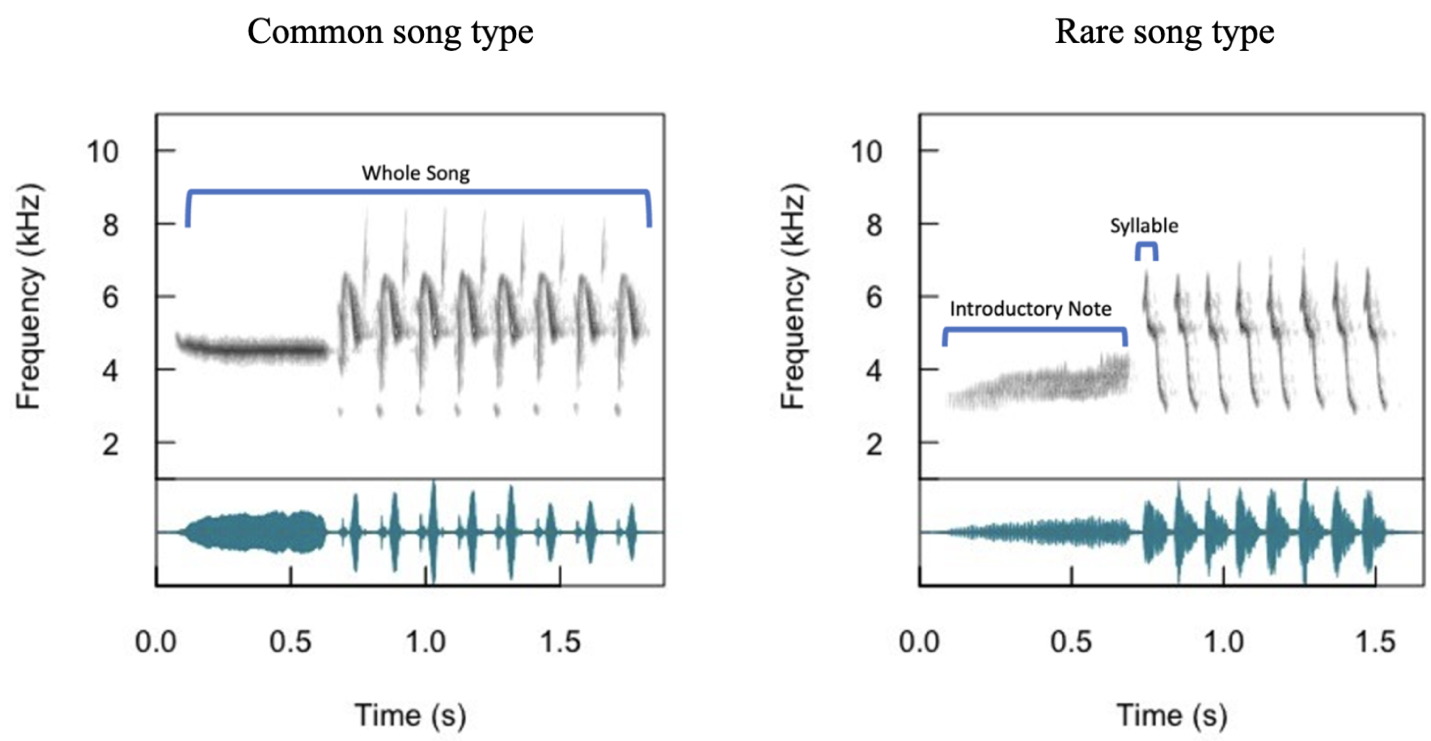
Just after dawn in a South Florida pine flatwoods, the light comes in low and sideways through the trunks, and the first thing you hear is not a bird at all; it's the pines themselves, hissing in the wind like static. Then, from somewhere in the wiregrass, a Bachman's sparrow begins to sing: one long, clear whistle, followed by a repetitive set of syllables. In the songbird literature, this is called a trill. Wait a minute, and he'll sing again but differently. A new whistle at a new pitch, a new trill with a different set of syllables. He is not repeating himself. He is working through a playbook of songs.
I spent my Ph.D. years in those flatwoods conducting my research, and the songs of Bachman's sparrows are truly mesmerizing. When a song leaves a sparrow's beak, what does the environment do to it on the way to the next set of ears? The answer, it turns out, may help explain something bigger: why some songs spread through a population and persist for generations, while others quietly vanish.
A sparrow with forty-eight songs
Bachman's sparrow (Peucaea aestivalis) is easy to overlook and hard to forget. It's a plain, warm-brown bird of the southeastern United States, a specialist of open, fire-maintained pine woodlands. Kind of savanna-like habitat, all grass and scattered pines, that frequent fire keeps the environment open, and that has become scarce across the Southeast, due to overdevelopment. As those pinelands have dwindled, so has the sparrow, which is why it is a species of real conservation concern.
What makes this modest bird remarkable is its voice. Males carry modestly large repertoires — on average, around 48 distinct song types per individual. And here's the curious part: those song types are not equally popular. Some are common, shared widely among the males of a population. Others are genuinely rare, sung by only 2-4 individuals. Because songbirds learn their songs, young males copy the adults they hear, the way children absorb an accent, a population's set of songs is a kind of culture, passed down ear to ear or generation to generation. So, the question practically asks itself: why do some songs catch on while others don't?
Sound does not travel through habitat unaltered. Every trunk, branch, and grass blade in the path of a song absorbs, reflects, or scatters a little of its energy. In open-type habitats, low-frequency sounds degrade faster than high-frequency ones. Echoes bouncing off vegetation smear crisp notes. Bioacousticians call it reverberation; you can think of it as the difference between speech in a quiet room and speech in a tiled stairwell. By the time a song has crossed a hundred meters of pineland, it is a degraded copy of itself: quieter, blurrier, sometimes overtaken with wind and insect noise.
Biologists have long suspected that this matters for evolution. The idea, known as the acoustic adaptation hypothesis, is that habitats should favor acoustic signals that travel well through them. It's an elegant idea. But whether habitat-filtered propagation actually helps determine which song types become common in a population, and which cultural variants persist, has remained surprisingly unclear. That's the gap my coauthors, Heather Wolverton and Rindy Anderson at Florida Atlantic University, and I set out to test.
Playing songs to the pines
The way you ask this question is charmingly direct: you make it listen to itself.
A sound propagation experiment works like a game of long-distance telephone with the habitat as the unreliable middleman. You take recorded songs, in our case, both common and rare Bachman's sparrow song types, and broadcast them through a loudspeaker placed out in a real pine flatwoods habitat, roughly where a sparrow would sing. Then you re-record those songs with microphones farther away and compare songs with no degradation to those with degradation at different distances. The difference between the two is the habitat's effects, and you can measure it: how much the song faded, how badly its fine structure blurred, how much lingering echo trailed behind each note, and how much of its loudness sank below the background noise.
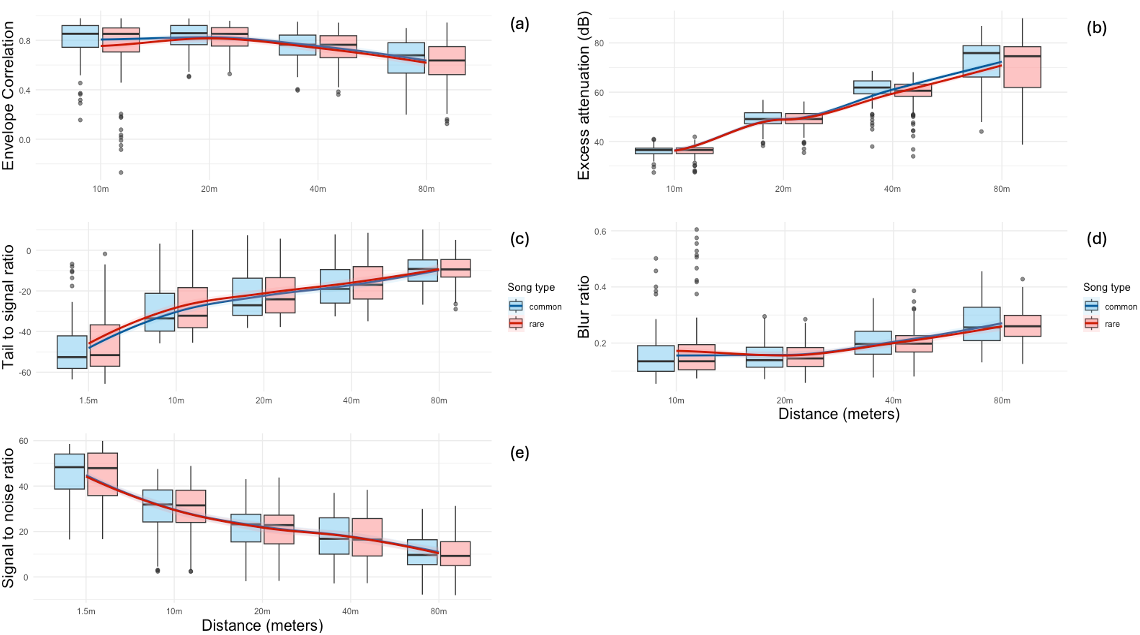
Each of those has a formal name in bioacoustics, and since you'll see them in the figures below, here is the plain-English version of our five degradation metrics:
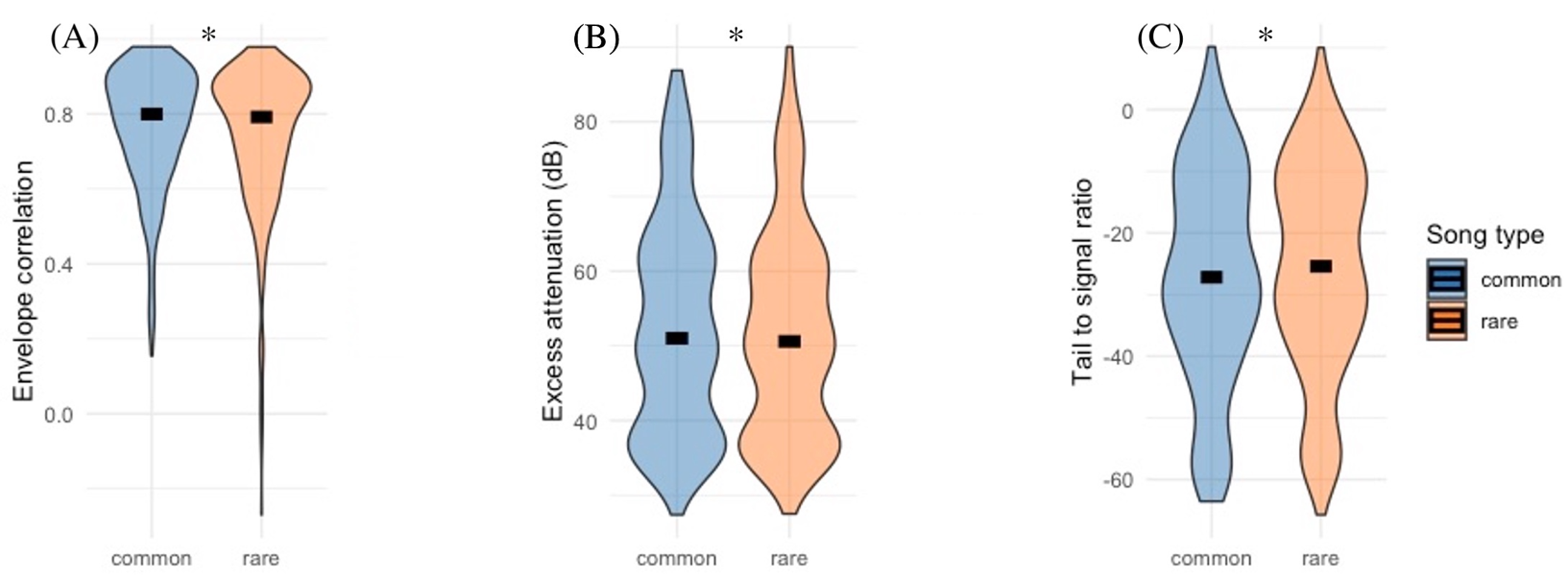
- Envelope correlation — how faithfully the song's rhythm survives the trip. Every song has a loudness contour — its pattern of swells and silences. We compare the contour that arrives with the one that left: a score near 1 means the song came through like a crisp photocopy; lower scores mean the pattern is warping.
- Excess attenuation — how much extra volume the habitat steals. All sound fades with distance by a predictable amount; this measures the loss beyond that baseline — the part you can blame on the pines, the palmettos, and the humid air.
- Tail-to-signal ratio — the echo problem. Every note drags a faint reverberant tail behind it as it bounces off trunks and vegetation. The bigger that tail is relative to the note itself, the muddier the song sounds — the tiled-stairwell effect.
- Blur ratio — how smeared the fine details get. A trill is a series of crisp, separate syllables; blur measures how much those sharp edges bleed into each other in transit.
- Signal-to-noise ratio — whether the song still stands out at all. A song can arrive intact but be buried under wind and insect noise; this measures how far above the background hum it rides.
We ran these experiments in South Florida pine flatwoods, and we didn't just measure the songs; we measured the entire stage. Tree density, wind speed, and the height at which the song was produced: all of it went into the analysis, because a forest is not one acoustic environment but many, shifting with the weather and the vegetation.
What the data told us
First, the songs themselves. When we analyzed the acoustic structure of common versus rare song types, notable differences emerged: the common types had higher frequencies, broader frequency bandwidths, and faster syllable rates — shorter gaps between their notes — than the rare types.
If you know the classic acoustic-adaptation logic, those results pretty much align with theory and expectation. Higher frequency, faster trilled songs are exactly the sort that textbook physics says should suffer less in vegetation. On top of that, when we compared the actual songs propagated through the flatwoods, the common types propagated better. They retained greater acoustic clarity during propagation, and they trailed less reverberant smear behind their notes. Also, common songs retained more amplitude than rare songs. Overall, the rare songs degraded more.
Culture with a filter
If common song types arrive at a listener's ears crisper and more intact, and rare types arrive smeared, especially in open habitats, then the physical environment may be placing a thumb on the scale of cultural transmission itself, helping decide which songs get copied and which fade from culture. The most widely shared songs "may have a built-in advantage because they remain clearer as they travel through the environment." However, our results did not paint a strong picture. While our results supported our original hypothesis, we found that habitat isn't the only factor shaping songs in a population. Birdsong is a product of both culture and environment, and the environment, it seems, gets an early vote. Many studies over decades have identified a combination of factors that shape song structure in songbirds, most notably habitat, sexual selection, and the bird's morphology (body size and beak shape). Our results also concluded that all three still play a role in shaping which songs are common and which are rare in Bachman's sparrows.
There's a conservation echo here, too. Bachman's sparrows depend on open pinelands kept open by fire. Change the structure of the habitat, and you don't just change where a sparrow can nest; you potentially can change what its songs sound like a hundred meters away, and perhaps what the next generation learns to sing.
Sources
- Gonzembach, H. R., Wolverton, H., & Anderson, R. C. (2026). Factors affecting acoustic propagation of birdsong: variation among song types and the effects of habitat on Bachman's sparrow (Peucaea aestivalis) song. Bioacoustics, 35(3). doi.org/10.1080/09524622.2026.2642902
- Florida Atlantic University News Desk (2026). Acoustic environment may shape which bird songs last
🪶 Hear it for yourself
My iOS game My Aviary Forest identifies the birds singing around you — entirely on your phone — and each one moves into your own little forest.