The Liar's Handicap: Why Animal Signals Stay (Mostly) Honest
From a toad's croak to a sparrow's trill, evolution keeps courtship advertising surprisingly truthful — because cheap talk gets ignored.
Every spring, the natural world becomes one enormous advertising campaign. Peacocks unfurl trains of iridescent eyespots on their tails. Red deer stags roar across Scottish glens until they're hoarse. Frogs inflate themselves into amphibious bagpipes. And in the marshes where I've spent many dawn hours with a microphone, swamp sparrows fire off trills.
All of this display raises a question that kept evolutionary biologists arguing for half a century: why should anyone believe any of it?
In biology, advertising invites exaggeration. The main point of animals' vocal advertising is to attract mates and deter rivals that may encroach on their territories. Strong, genetically fit males produce distinct acoustic features in their vocalizations that signal to receivers their genetic quality as a potential mate or rival. A weak male who could bluff his way past rivals or charm a female with an inflated sales pitch would leave more offspring than an honest one — and his dishonest genes would spread. Follow that logic for a few generations, and every signal should collapse into meaningless noise, ignored by all. Yet that's not what we see. Across the animal kingdom, courtship displays and threat signals tend to be reliable: the deep roar really does come from the big stag, the impressive song really does come from the fit singer. Something keeps the advertising honest. What?
Zahavi's expensive idea
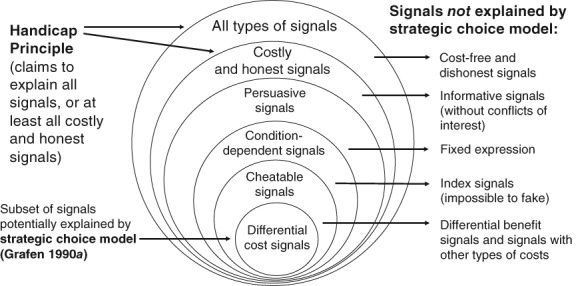
In 1975, the Israeli ornithologist Amotz Zahavi proposed a famously counterintuitive answer: signals are believable because they are costly. A peacock's train is a burden — heavy, conspicuous, a liability with predators — and only a genuinely high-quality male can afford to survive while lugging it around. The handicap, Zahavi argued, is the very thing that makes the message trustworthy, like a billionaire proving his wealth by setting money on fire.
It's a seductive idea, and versions of it appear in nearly every textbook. But biologists have spent the decades since sharpening, and in places, rewriting it. A major open-access review by Dustin Penn and Szabolcs Számadó traces how Zahavi's original claim (that selection favors waste for its own sake) doesn't hold together logically: evolution cannot favor a trait because it reduces survival and reproduction. What later mathematical work actually showed is subtler and more satisfying. Honesty doesn't require signals to be wasteful; it requires that cheating cost more for low-quality individuals than honesty costs for high-quality ones. A fit male can produce a spectacular display relatively cheaply, the way a trained marathoner can jog a mile without breaking a sweat. A weakling attempting the same display pays dearly, in energy, in predation risk, and in simply failing partway through. The books balance differently for honest signalers and would-be liars, and that difference is what keeps the system truthful. Signalers, it turns out, aren't burning money to impress. They're making strategic investments that only the wealthy can afford.
Signals the body can't fake
Some signals are honest for an even simpler reason: physics.
Consider the croak of a frog. Vocal pitch is set largely by the size of the structures producing it — big bodies house big vocal apparatus, which vibrates at low frequencies. A small frog cannot produce the resonant baritone of a large one, any more than a violin can impersonate a cello. Biologists call these index signals: cues welded to the trait they advertise by anatomical constraint. Frogs sizing up rivals by croak, and red deer stags assessing each other's roars, are reading a signal that can't easily lie. No cost accounting needed; the message and the messenger are physically the same thing.
But evolution never leaves a loophole unexplored, and here the story takes a wonderful twist. A 2016 open-access study by Benjamin Charlton and David Reby analyzed the calls of 72 mammal species and found that in lineages under intense sexual competition — where males are much larger than females — males have evolved anatomical tricks to sound bigger than they are. The key is something called formant spacing: the pattern of resonances a call picks up as it passes through the vocal tract, which serves as an acoustic ruler for body length. By evolving lowered larynges and stretched vocal tracts, males in these species shift their formants downward, projecting the voice of a larger animal. Red deer are champion exaggerators. Female red deer, for their part, prefer the roars of larger-sounding males, while female koalas read the same formant cues in their suitors' improbably deep bellows.
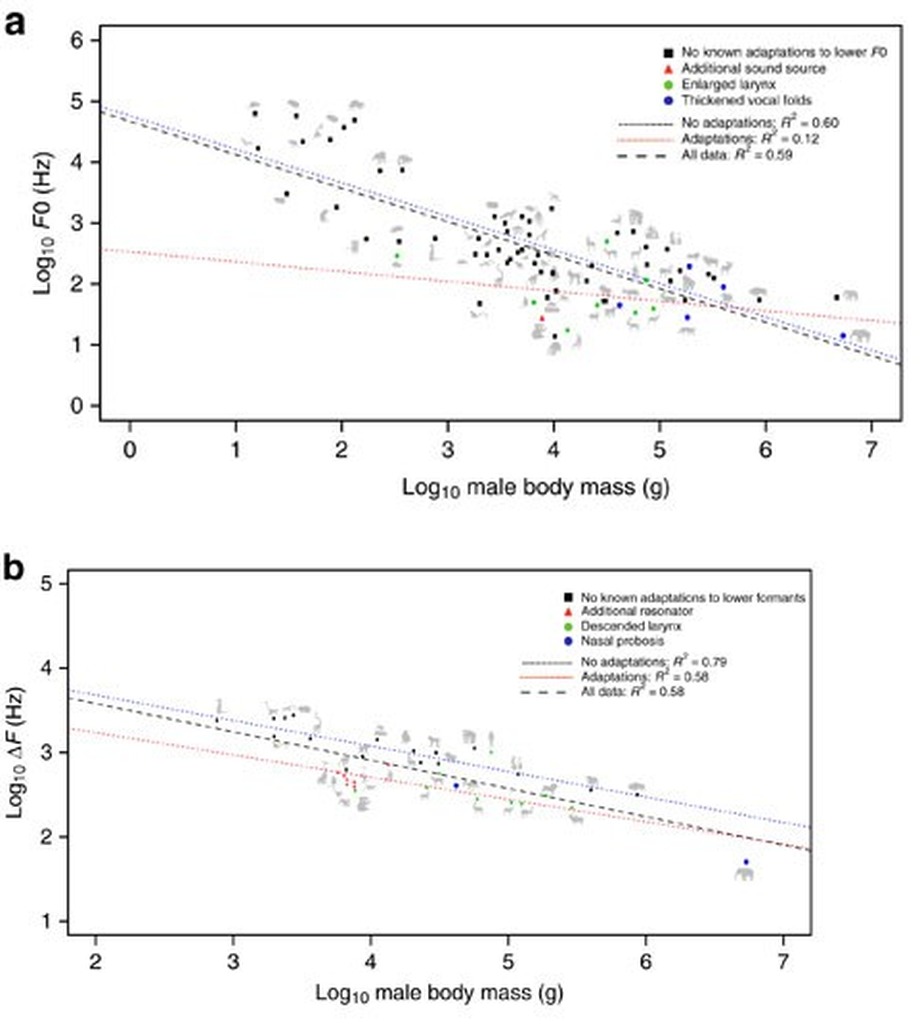
Is that dishonesty? Not quite. Every male in the species inherits roughly the same exaggerated anatomy, so the whole population shifts together — an arms race of inflation, like grade inflation, in which the relative rankings still carry real information. The ruler has been stretched, but it still measures.
A sparrow's tongue-twister
Birdsong offers my favorite version of unfakeable honesty, because the constraint isn't size, it's skill.
Many species of songbirds sing trilled songs. A single note repeated in rapid succession. Producing a trill means re-tuning the vocal tract. This includes the beak, tongue, and vibrating membranes in the syrinx, for every single note, dozens of times per second. And there's a catch, visible on any spectrogram: the faster a bird trills, the narrower the range of frequencies each note can sweep through. Fast and wide is the vocal equivalent of a tongue-twister at auctioneer speed. Plot real songs on a graph of trill rate against frequency bandwidth, and they fall under a hard ceiling. A performance limit that the best singers approach, and no singer can physically exceed.
In a now-classic experiment, Barbara Ballentine, Jeremy Hyman, and Stephen Nowicki asked whether female swamp sparrows actually care. They played female matched pairs of songs — same song type, but one version closer to the performance ceiling than the other. Females displayed far more courtship toward the high-performance versions. The birds, in other words, are grading each other against the physical limit. You cannot fake a fast, wide trill for the same reason you cannot fake a four-minute mile: the performance is the proof.
The skeptical audience
Notice who's really running this show: the receivers. Signals stay honest because listeners evolved to be ruthless skeptics — attending only to the cues that can't be faked cheaply, discounting the ones that can, and abandoning any signal that stops predicting quality. Every unfakeable roar and punishing trill is the fossil record of ancient audiences refusing to be fooled. Honest signaling isn't a gentleman's agreement among the animals; it's the uneasy truce left over from an endless arms race between advertisers and their critics.
That's worth remembering next time you're standing in a spring dawn chorus. All that beauty is data. Each song is a verifiable credential, shaped by generations of skeptical ears. It's part of why birdsong is such a gift to naturalists: those acoustic signatures are stable and species-typical enough that you can learn to read them yourself.
Sources
- Penn, D. J., & Számadó, S. (2020). The Handicap Principle: how an erroneous hypothesis became a scientific principle. Biological Reviews, 95(1), 267–290. Open access: https://doi.org/10.1111/brv.12563 (PMC7004190)
- Charlton, B. D., & Reby, D. (2016). The evolution of acoustic size exaggeration in terrestrial mammals. Nature Communications, 7, 12739. Open access: https://doi.org/10.1038/ncomms12739 (PMC5025854)
- Ballentine, B., Hyman, J., & Nowicki, S. (2004). Vocal performance influences female response to male bird song: an experimental test. Behavioral Ecology, 15(1), 163–168. https://doi.org/10.1093/beheco/arg090
🪶 Hear it for yourself
My iOS game My Aviary Forest identifies the birds singing around you — entirely on your phone — and each one moves into your own little forest.